LOGICAL THINKING PROCESS
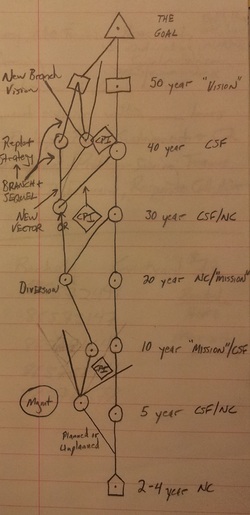
Maybe your business strategy is like this example. You plan for deviation. You plan for uncertainty. You plan to be derailed and hope that clarity will rescue victory from the jaws of defeat!
Wouldn't a method that logically identifies solutions to overcome risks provide greater stability and achievement of your goal? Whether starting a new business venture, jump-starting stagnant performance, overcoming unpredicted impacts, or solving simple or complex conflicts you need LTP.
The Logical Thinking Process (LTP) brings cause-and-effect order to what seems to be chaos through the Intermediate Objective (IO) Map, Current Reality Tree (CRT), Evaporating Cloud, Future Reality Tree (FRT), Prerequisite Tree (PRT), and Executive Summary Tree. (1)
Each of these products brings deep understanding of your business, competitive and market environments, and analysis of required actions that will shape the future for success. Together, they identify 1) What to Change, 2) What to Change TO, and 3) How to Bring About the Change.
Maybe your business strategy is like this example. You plan for deviation. You plan for uncertainty. You plan to be derailed and hope that clarity will rescue victory from the jaws of defeat!
Wouldn't a method that logically identifies solutions to overcome risks provide greater stability and achievement of your goal? Whether starting a new business venture, jump-starting stagnant performance, overcoming unpredicted impacts, or solving simple or complex conflicts you need LTP.
The Logical Thinking Process (LTP) brings cause-and-effect order to what seems to be chaos through the Intermediate Objective (IO) Map, Current Reality Tree (CRT), Evaporating Cloud, Future Reality Tree (FRT), Prerequisite Tree (PRT), and Executive Summary Tree. (1)
Each of these products brings deep understanding of your business, competitive and market environments, and analysis of required actions that will shape the future for success. Together, they identify 1) What to Change, 2) What to Change TO, and 3) How to Bring About the Change.
|
SIMPLIFIED STRATEGY
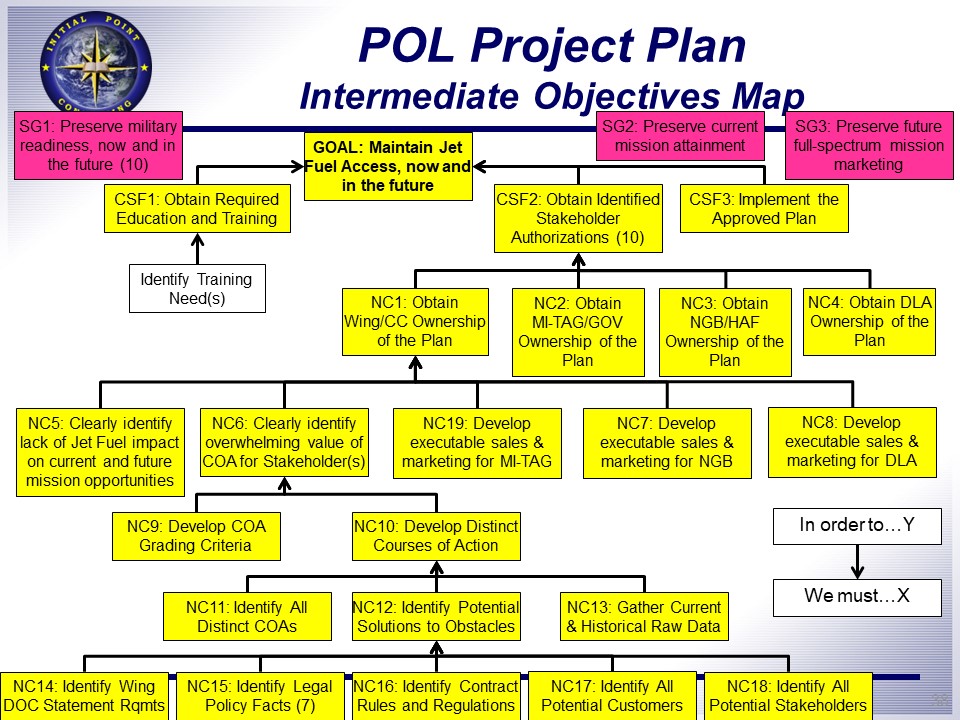
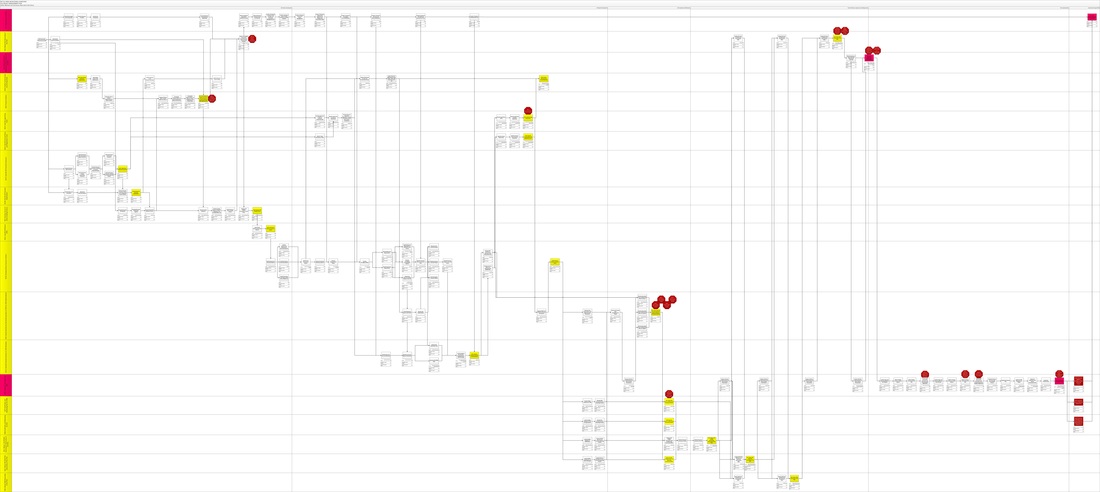
A variation on LTP is the use of three tools together in the ID/IO Simplified Strategy. (2) The first is the Interference Diagram, an intuition-based tool to surface obstacles to the goal. This tool allows the user to quickly identify the general direction of actions and make rapid progress toward success. The major client challenge was to maintain generic statements that allowed for objective investigation of the full range of options. The second tool is the Intermediate Objective Map, a logic-based tool used to organize identified actions into Necessary Conditions that achieve Critical Success Factors essential to success. This step does not regard the time-phasing of actions but looks at identification of the progression of dependency to attain the goal. Although Sproull mentions building the Plan of Action, the IO Map may morph into a Prerequisite Tree (PRT) or Plan of Actions and Milestones to create the roadmap for project management. Here the Necessary Conditions are depicted in Yellow, Critical Success Factors in Magenta, and the point at which identified Obstacles are overcome in Red stop signs. Critical Chain Project Management can now begin to realize the identified goal. Depicted is the culmination of the Interference Diagram, Intermediate Objective Map, and Project Management development. |
CONFLICT CLOUD
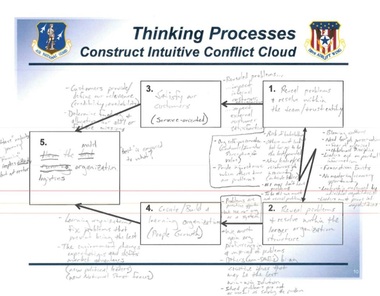
When a compromise solution fails to bring success and win-win solutions, it is usually the underlying assumptions that are preventing positive action.
The Conflict Cloud clarifies the views surrounding the issue and provides a framework for identifying win-win solutions.
When a compromise solution fails to bring success and win-win solutions, it is usually the underlying assumptions that are preventing positive action.
The Conflict Cloud clarifies the views surrounding the issue and provides a framework for identifying win-win solutions.
1) Dettmer, H. W., (2003) Strategic Navigation: A Systems Approach to Business Strategy.
2) Sproull, Bob, (2012) Epiphanized: Integrating Theory of Constraints, Lean and Six Sigma.
2) Sproull, Bob, (2012) Epiphanized: Integrating Theory of Constraints, Lean and Six Sigma.